
FDA on Tampon Safety

Tampon Study
Conducted 29 May 2026
In May 2026, the FDA published a study evaluating the potential health risks of metals in tampons in response to a 2024 study by outside researchers that identified metals in tampon materials but did not assess whether those metals posed a health risk. The FDA study, "Do Metals in Tampons Pose a Health Risk? A Toxicological Risk Assessment Study," concluded that "U.S.-marketed tampons do not pose a health risk from toxic metal exposure."
Read the full study here: https://academic.oup.com/toxsci/article/209/6/kfag065/8698879?login=true
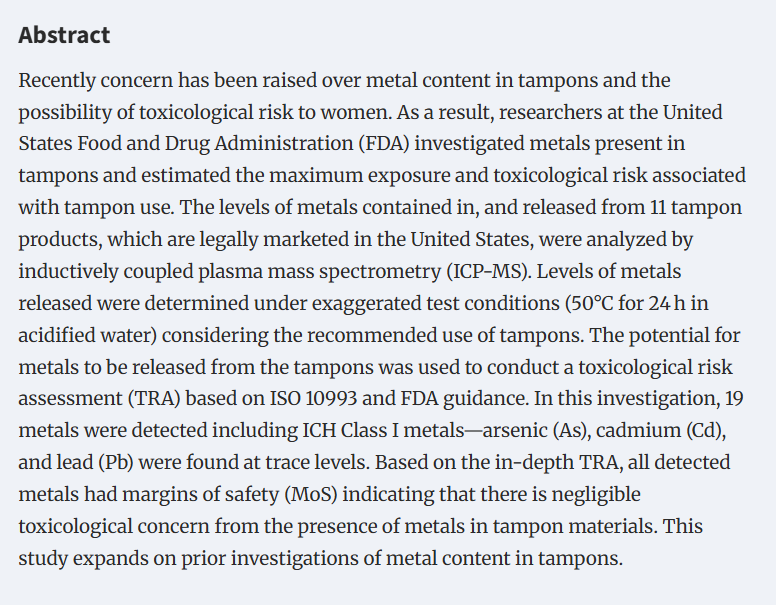
The FDA found that while trace levels of metals were detected in tampons, toxicological risk assessments indicated negligible toxicological concern from their presence in tampon materials when used as intended.
Finding a substance in a product does not automatically mean it is harmful. Today's testing methods are so sensitive that they can detect extremely small amounts of many substances. What matters is not just whether a substance can be detected, but whether people are exposed to enough of it to affect their health. To answer that question, scientists evaluate how much of a substance could be released during normal use and compare that amount to established safety levels. Based on this assessment, the FDA concluded that the detected metals did not present a meaningful health risk under the intended conditions of use.
Class II Medical Devices
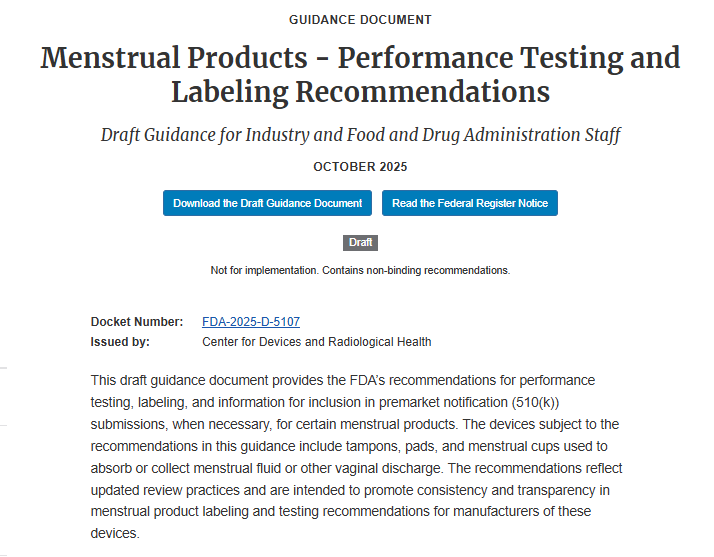
Tampons are regulated by the U.S. Food and Drug Administration (FDA) as Class II medical devices. Before they can be legally marketed in the United States, manufacturers must demonstrate that their products meet FDA requirements for safety and effectiveness. Manufacturers are also required to comply with FDA regulations governing design, manufacturing, quality controls, labeling, and post-market oversight to help ensure these products remain safe for consumers.
If you use tampons during your period (or menstruation), it’s important to know how to use them safely. Consider this important information from the U.S. Food and Drug Administration — and please share this information with other women who may use these products.
What are tampons — and how are they used?
Tampons are one method of absorbing menstrual flow during your period. Tampons are designed to be inserted into the vagina with or without an applicator.
You may be surprised to learn that the FDA regulates tampons as medical devices. Tampons cleared by the FDA are meant to be used one time and then thrown away. No tampon should be used more than once.
What are tampons made out of?
FDA-cleared tampons are made of cotton, rayon, or a blend of the two. The absorbent fibers used in FDA-cleared tampons sold today are made with a bleaching process that is free from elemental chlorine, which also prevents products from having dangerous levels of dioxin (a type of pollutant found in the environment).
How does FDA evaluate the safety of tampons?
Before any tampons can be legally sold in the U.S., they must go through the FDA’s review to determine whether they are as safe and effective as (substantially equivalent to) legally marketed tampons.
As part of the FDA’s review, manufacturers submit data including the results of testing to evaluate the safety of the materials used to make tampons and applicators (if present); tampon absorbency, strength, and integrity; and whether tampons enhance the growth of certain harmful bacteria or change normal bacteria levels in the vagina.
Are reusable tampons safe?
Reusable tampons may carry additional risks of infections such as yeast, fungal, and bacterial infections.
While you may have heard about reusable tampons, the FDA has not cleared or approved these products. The FDA discourages the use of reusable tampons.
The only tampons cleared or approved by the FDA are designed for single use.
What should you know about tampons and toxic shock syndrome (TSS)?
Toxic shock syndrome (TSS) is rare and is caused by a toxic substance that is produced by certain kinds of bacteria. The toxic substance produced by the bacteria can cause organ damage (including kidney, heart, and liver failure), shock, and even death.
Rates of reported TSS cases associated with tampons have declined significantly over the years. One reason is that the FDA evaluates whether a tampon enhances the growth of the bacteria that causes TSS before the product can be legally marketed. Only tampons that have been cleared by the FDA can be legally marketed in the U.S. In addition, more informative tampon labeling, as well as educational efforts by the FDA and manufacturers, may have contributed to the reduction in TSS cases. For more information on TSS, see the tampon safety tips, below.